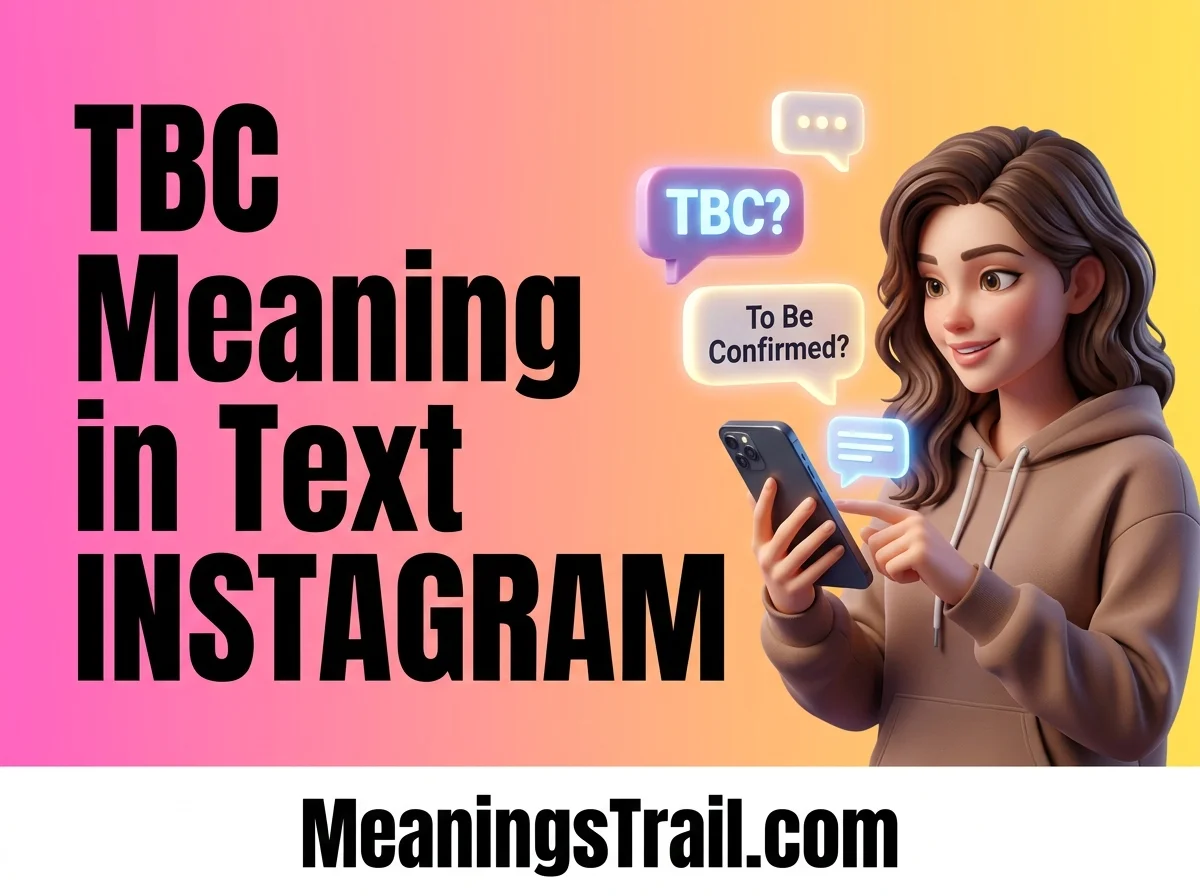
If someone sends you “TBC Meaning in Text” in a text, you may wonder what they actually mean. Is it “to be confirmed”? Does it mean “to be continued”? Or is it another slang term you have never seen before?
This is why many people search for “TBC Meaning in Text“. The same three letters can have differentmeanings depending on the message, the topic, and the place where you see them.
A friend may use TBC when talking about weekend plans, while someone at work may use it when a date or detail is not final yet. On social media, it can also appear at the end of a story or post to suggest that more is coming.
The good news is that “TBC Meaning in Text” is usually easy to understand once you look at the words around it. In most everyday texts, it means “to be confirmed” or “to be continued.”
This guide explains the common meanings of TBC, how people use it in real conversations, and how you can respond without guessing the wrong meaning.
What Does “TBC Meaning in Text” Mean in Text?
In texting, TBC usually means “to be confirmed” or “to be continued.” “To be confirmed” is common when a plan or detail is not final, while “to be continued” suggests that a story, conversation, or situation will continue later. The correct meaning depends on the context, sentence, and conversation.
Other less common meanings can appear in specific groups or industries, but they are much less likely in normal texting.
The Most Common Meanings of “TBC Meaning in Text”
1. TBC = To Be Confirmed
The most common meaning of TBC in planning and everyday communication is “to be confirmed.”
People use it when something is expected but has not been finalized yet. This could be a time, place, date, meeting, event, or other detail.
For example:
“Dinner is Friday, time TBC.”
This means the dinner is planned for Friday, but the exact time has not been decided.
Another example:
“The party is next weekend, location TBC.”
Here, the person knows the party is happening but does not yet know or want to share the final location.
TBC is useful because it gives people an update without pretending that something is certain.
You may also see it written as:
- “Time: TBC”
- “Date: TBC”
- “Venue: TBC”
- “Details TBC”
In these cases, “to be confirmed” is almost certainly the intended meaning.
2. TBC = To Be Continued
TBC can also mean “to be continued.”
This meaning is common when someone is telling a story, sharing a dramatic event, or creating suspense.
For example:
“Then I opened the door and saw who was standing there… TBC.”
The writer is saying that the story is not finished yet.
You might see this meaning in:
- Social media posts
- Stories
- Videos
- Online discussions
- Personal messages
- Jokes
- Dramatic updates
If someone tells you a long story and ends with “TBC,” they may simply mean, “I’ll tell you the rest later.”
3. TBC = A Detail Is Not Final Yet
Sometimes TBC does not refer to one specific plan. It simply tells the reader that more information will come later.
For example:
“We might go to the beach Sunday. TBC.”
This can mean the plan itself still needs confirmation.
Another example:
“New schedule TBC.”
This means the schedule has not been finalized.
The key idea is uncertainty. Something may happen, but the person is not ready to call it final.
4. TBC in a Group or Community
In group chats, clubs, gaming groups, school groups, or online communities, TBC can also be used for information that has not been settled.
For example:
“Tournament start time: TBC.”
Everyone knows there will probably be a tournament, but the start time has not been announced.
This use is especially common because short abbreviations save space and make updates easy to scan.
How “TBC Meaning in Text” Is Used in Real Conversations
The meaning of TBC can change slightly depending on where you see it. Looking at the setting is one of the easiest ways to understand it.
Friends & Casual Texting
Friends often use TBC when making plans.
For example:
“Movie tomorrow?”
“Yeah, probably. Time TBC.”
Here, TBC means the time has not been decided yet.
Another example:
“We’re meeting Saturday. Place TBC.”
The person has agreed to meet but still needs to decide where.
In casual texting, people may also use TBC loosely:
“Beach trip this month… TBC.”
This could mean the trip is still uncertain or that the final details are unknown.
If the conversation is about plans, assume “to be confirmed” first.
Instagram & Snapchat
On Instagram and Snapchat, TBC can have either major meaning.
When someone is sharing plans, TBC often means “to be confirmed.”
For example:
“Next trip coming soon. Destination TBC.”
But when someone is telling a story, TBC may mean “to be continued.”
For example:
“You will not believe what happened next. TBC.”
In social media captions, people may use TBC to create curiosity. It can make followers wonder what happens next.
So look at the content before deciding what TBC means.
If the post is about a plan, it probably means “to be confirmed.”
If the post is about a story, it probably means “to be continued.”
Dating Apps
TBC is less common in dating conversations, but it can still appear.
For example:
“Drinks this weekend? Time TBC.”
This simply means the date is likely to happen, but the exact time is not settled.
Someone might also say:
“Our second date? TBC.”
This could be playful. It may mean they have not decided whether another date will happen.
The tone matters here.
If someone writes:
“Future husband status: TBC”
they may be joking about the uncertainty of dating.
If someone writes:
“Date location TBC”
they are probably just discussing logistics.
TBC itself is not automatically romantic or flirty.
Gaming & Online Communities
Gamers and online groups often use TBC for events, matches, updates, and schedules.
For example:
“Next match: Saturday, time TBC.”
That means the match is planned, but the time has not been confirmed.
You may also see:
“New event TBC.”
This means more information about the event will be announced later.
In gaming communities, TBC can sometimes be confused with other game-specific abbreviations. Therefore, if the message includes unusual terms, check the rest of the conversation before assuming the meaning.
Work or Professional Chat
TBC is very common in professional communication.
You may see:
“Meeting date: TBC.”
“Client response: TBC.”
“Final budget: TBC.”
In these examples, TBC almost always means “to be confirmed.”
It is especially useful in schedules, project plans, calendars, event information, and internal messages.
However, there is an important difference between professional and casual use.
At work, TBC should normally refer to something that genuinely needs confirmation. It should not be used to hide a lack of preparation.
For example:
“Project deadline: TBC”
is useful if management has not finalized the deadline.
But if you already know the deadline and simply have not checked it, a clearer message would be better.
Is “TBC Meaning in Text” Rude, Flirty, or Offensive?
TBC is generally not rude, offensive, or flirty.
It is a neutral abbreviation. Its tone comes from the surrounding message rather than from the letters themselves.
When TBC Feels Neutral
Consider:
“Dinner time TBC.”
This sounds completely normal and practical.
The person is simply saying that the time has not been confirmed.
When TBC Feels Playful
TBC can become playful when someone uses it in a joke.
For example:
“Will I finally clean my room today? TBC.”
The person is joking about whether they will actually do it.
Another example:
“Will I survive this exam? TBC.”
The abbreviation adds a humorous sense of uncertainty.
When TBC Feels Negative
The abbreviation itself is not negative, but the situation can make it feel that way.
For example:
“Are we still meeting?”
“TBC.”
If the person previously promised a definite plan, this short answer may feel uncertain or dismissive.
The problem is not the abbreviation. It is the lack of detail.
A clearer answer might be:
“I’m not sure yet. I’ll confirm tonight.”
That feels more helpful.
Is TBC Flirty?
Usually, no.
If someone says:
“Second date? TBC.”
it could sound playful, teasing, or uncertain depending on the relationship.
The surrounding conversation matters much more than the abbreviation.
Do not assume someone is flirting just because they use TBC.
How to Respond When Someone Says “TBC Meaning in Text”
Your response should depend on what they mean and how formal the conversation is.
Casual Replies
If a friend says:
“Time TBC.”
You can reply:
- “Sure, just let me know.”
- “Sounds good.”
- “No worries.”
- “Keep me posted.”
- “Okay, tell me when it’s confirmed.”
These responses work well because they do not put pressure on the other person.
Funny Replies
If the conversation is playful, you can joke back:
- “TBC? I’ll wait for the official announcement.”
- “Keeping me in suspense, huh?”
- “Okay, mystery time.”
- “I’ll check back for the next episode.”
Use funny replies only when the relationship is casual and the situation allows it.
Neutral Replies
If you are unsure about the situation, use a simple question:
“Do you mean the time is still unconfirmed?”
Or:
“When do you think you’ll know?”
This is useful because TBC can have more than one meaning.
Professional Replies
In a work setting, keep your answer clear:
“Thanks. Please let me know once the time is confirmed.”
Or:
“Understood. I’ll wait for the confirmed details.”
This avoids confusion and keeps the conversation professional.
Common Misunderstandings About “TBC Meaning in Text”
TBC is short, but it can still cause confusion.
Mistake 1: Thinking TBC Always Means “To Be Continued”
Many people first learn TBC from stories or entertainment. Because of this, they may assume it always means “to be continued.”
That is not true.
If you see:
“Meeting location TBC”
the meaning is clearly “to be confirmed.”
Mistake 2: Thinking TBC Always Means “To Be Confirmed”
The opposite mistake can happen too.
If someone writes:
“And then she texted me back… TBC.”
they are probably saying “to be continued.”
The story context gives you the answer.
Mistake 3: Treating TBC as Slang
TBC is often called texting slang because it appears in chats, but it is more accurately described as an abbreviation.
It is used in casual conversations, but it is also common in professional schedules, event listings, project documents, and planning.
Mistake 4: Assuming It Means Something Negative
TBC does not automatically mean someone is avoiding you.
If a friend says:
“Plans TBC.”
they may simply not know the final details yet.
You need to look at the full conversation before judging their tone.
Mistake 5: Confusing TBC With Similar Abbreviations
TBC can look similar to other short terms, especially when messages are written quickly.
For example, people may confuse it with abbreviations such as TBD or TBH.
But they are different:
- TBC = To Be Confirmed / To Be Continued
- TBD = To Be Determined
- TBH = To Be Honest
Knowing the exact abbreviation can prevent a completely different interpretation.
Similar Slang Terms You Should Know
Here are some related texting abbreviations that can appear in similar conversations:
- TBD — To Be Determined; something has not been decided yet.
- TBH — To Be Honest; used before giving an honest opinion.
- BRB — Be Right Back; the person will return shortly.
- BTW — By The Way; used to add another point.
- FYI — For Your Information; shares information without necessarily asking for action.
- IMO — In My Opinion; introduces a personal view.
- IDK — I Don’t Know; shows uncertainty or lack of knowledge.
- NVM — Never Mind; tells someone to ignore the previous point.
- LMK — Let Me Know; asks someone to provide an update.
- TBA — To Be Announced; information will be announced later.
- ASAP — As Soon As Possible; asks for something quickly.
- ETA — Estimated Time of Arrival; asks or gives an expected arrival time.
One useful distinction is between TBC, TBD, and TBA.
TBC usually means something needs confirmation.
TBD means a decision still needs to be made.
TBA means the information will be announced later.
These can overlap in some situations, but they are not always interchangeable.
When You Should Avoid Using “TBC Meaning in Text”
TBC is easy to understand in many situations, but there are times when writing the full phrase is better.
Professional Settings
Although TBC is common at work, avoid it when the reader may not understand abbreviations.
For important emails, contracts, formal notices, or external communication, write:
“The date is still to be confirmed.”
instead of:
“Date TBC.”
Clear language is usually better when accuracy matters.
Cross-Cultural Chats
Not every person or language community uses English abbreviations in the same way.
If you are speaking with someone who may not know common English texting terms, spell it out.
For example:
“The exact time is still to be confirmed.”
This removes the need for guessing.
Sensitive Situations
Avoid using TBC when someone needs a direct and clear answer.
For example, if someone asks:
“Is the appointment happening tomorrow?”
Replying only:
“TBC.”
may leave them more confused.
A better response is:
“I’m still waiting for confirmation. I’ll let you know as soon as I hear back.”
This gives useful information instead of only an abbreviation.
Important Plans
If travel, work, school, money, or an appointment depends on your answer, be more specific.
Instead of:
“TBC.”
say:
“The time has not been confirmed yet. I should know by Friday.”
This tells the other person both the current status and what to expect next.
FAQs
What does TBC mean in text messages?
TBC most commonly means “to be confirmed” or “to be continued.” The correct meaning depends on the context. Plans and schedules usually use “to be confirmed,” while stories often use “to be continued.”
What does TBC mean on social media?
On social media, TBC can mean either “to be confirmed” or “to be continued.” A post about plans usually uses the first meaning, while a story or dramatic update often uses the second.
Is TBC a slang word?
TBC is better described as an abbreviation than traditional slang. People use it in texting, social media, group chats, planning, and professional communication.
Is TBC rude in texting?
No. TBC is normally neutral. However, replying with only “TBC” can feel unhelpful if someone needs a clear answer. The tone depends on the situation and the rest of the conversation.
Does TBC mean to be confirmed or to be continued?
It can mean either. “To be confirmed” is common for plans, dates, times, and details. “To be continued” is common when someone is telling a story or leaving an event unfinished.
What is the difference between TBC and TBD?
TBC usually means “to be confirmed,” while TBD means “to be determined.” TBC often suggests that information exists but still needs confirmation. TBD usually means the decision itself has not been made.
Can I use TBC in a professional message?
Yes, especially in schedules, project plans, and internal communication. However, for formal or important messages, spelling out “to be confirmed” may be clearer for readers who are unfamiliar with the abbreviation.
Final Thoughts.
The meaning of TBC in text is usually simple once you look at the conversation around it. In most cases, it means “to be confirmed” or “to be continued.”
Use the topic to work out which meaning applies.
If someone is discussing a meeting, event, date, time, location, or plan, TBC most likely means “to be confirmed.” If someone is telling a story, sharing an unfinished update, or creating suspense, it may mean “to be continued.”
TBC is generally neutral. It is not automatically rude, flirty, or offensive. Still, context matters. A short “TBC” may be fine between friends but too vague when someone needs an important answer.
When you are unsure, do not guess. Look at the words around TBC or simply ask what the person means. Clear communication is always better than relying on an abbreviation.
The next time you see “TBC” in a message, you should be able to understand it quickly and respond with confidence.

Grace Wilson is a passionate writer and language enthusiast who enjoys exploring word meanings and making complex ideas easy to understand.