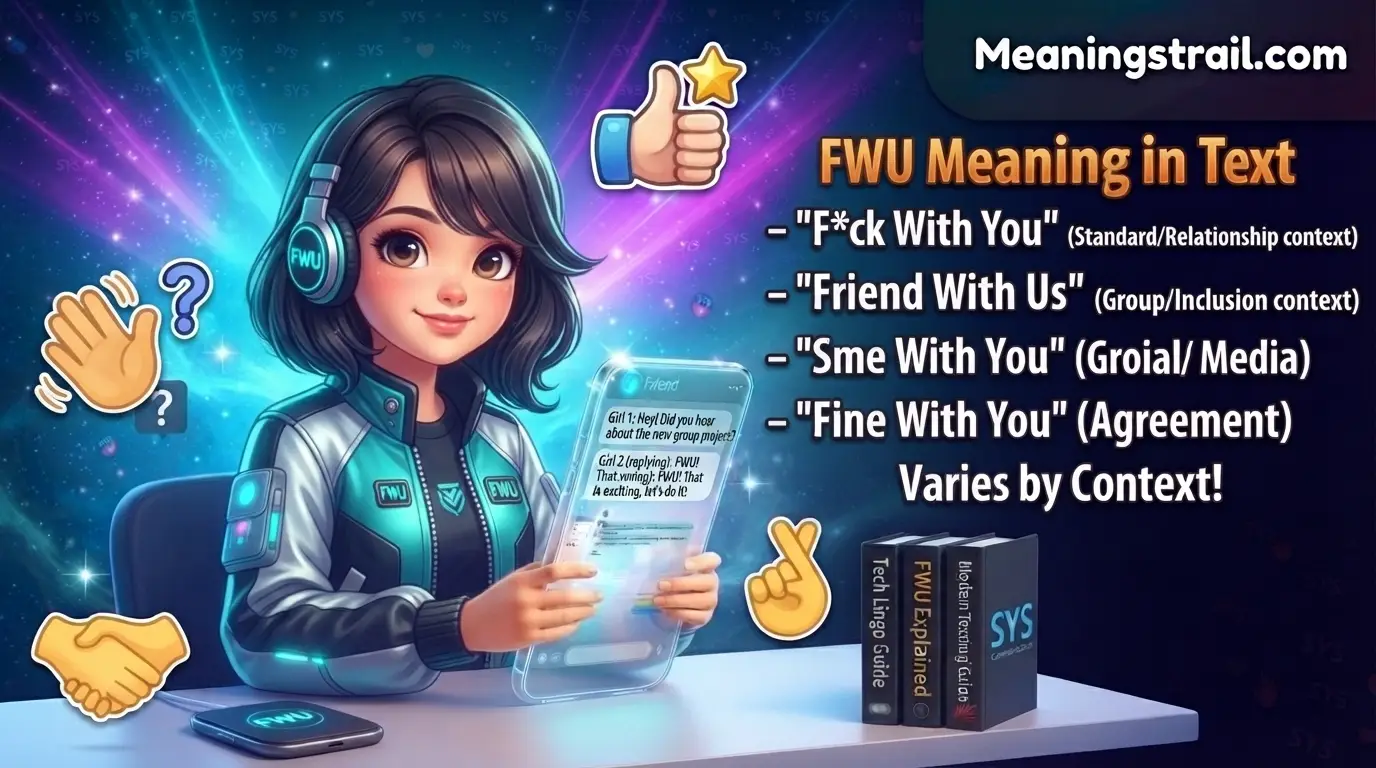
Have you ever received a text that says “I FWU Meaning in Text” and wondered what the other person is trying to tell you? You are not alone. Short forms are common in online chats, and some can have more than one meaning. If you do not know the slang, even a simple message can feel confusing.
The FWU meaning in text is usually “fuck with you,” a casual slang phrase that can mean liking someone, supporting them, trusting them, or wanting to spend time with them. In some conversations, it can also suggest romantic interest. The exact meaning depends on the words around it and the relationship between the people talking.
For example, when a friend says, “I FWU Meaning in Text, bro,” they may mean that they like you and have your back. When someone says, “I really fwu,” the message may express stronger interest or closeness.
People search for this term because they want to understand texts, social media comments, dating messages, and online conversations. This guide explains the common meanings of FWU Meaning in Text, how people use it, how to respond, and when it is better to avoid it. By the end, you will be able to understand the phrase more clearly and use it with confidence.
What Does “FWU Meaning in Text” Mean?
FWU Meaning in Text usually stands for “fuck with you.” In casual texting, it often means that someone likes you, supports you, enjoys your company, or wants to keep a connection with you. Depending on the conversation, it may show friendship, trust, attraction, or a willingness to associate with someone. The phrase is informal and can sound rude in professional settings.
The phrase does not always carry a negative meaning, even though it contains a swear word. In many casual conversations, it expresses a positive feeling toward another person.
For example:
- “I fwu” can mean “I like you” or “I support you.”
- “I don’t fwu” can mean “I don’t like you” or “I don’t want to associate with you.”
- “You know I fwu” can mean “You know I have your back.”
- “Do you fwu?” can mean “Are you interested in me or comfortable with me?”
The surrounding conversation helps you understand which meaning fits best.
The Most Common Meanings of “FWU”
FWU can communicate different feelings, even when the basic phrase stays the same. Here are the most common interpretations.
1. I Like You
One common use of FWU Meaning in Text is to show that someone likes you or enjoys being around you. The person may appreciate your personality, enjoy talking to you, or feel comfortable in your company.
Example:
Person A: “We always have fun when we hang out.”
Person B: “Fr, I fwu.”
Here, “fr” means “for real.” Person B is saying that they genuinely enjoy the connection.
This use can describe friendship, so it does not automatically mean romantic love.
2. I Support You
FWU can also show support and loyalty. Someone may use it to tell a friend that they stand by them or respect them.
Example:
Person A: “Everyone keeps doubting my plans.”
Person B: “Don’t worry, I fwu. Keep going.”
In this example, the message means that Person B believes in the other person and wants them to succeed.
This meaning is common when people talk about personal goals, difficult situations, or problems with other people.
3. I Trust You or Have Your Back
In some conversations, FWU Meaning in Text communicates trust. It can suggest that someone is loyal to you and is willing to stand beside you.
Example:
Person A: “You can tell me what happened. I won’t judge you.”
Person B: “Thanks. That’s why I fwu.”
The phrase shows appreciation for the person’s support and trustworthiness.
However, FWU Meaning in Text is not a formal promise. If someone uses it, look at their actions as well as their words before deciding how much trust to place in them.
4. I’m Interested in You
FWU may have a flirty meaning when it appears in a conversation between people who are getting to know each other romantically.
Example:
Person A: “You always make me smile.”
Person B: “Because I fwu.”
In this situation, Person B may be suggesting attraction or a desire to become closer.
Still, the phrase alone does not prove that someone has romantic feelings. Some people use it casually with friends, so it is important to consider the full conversation.
5. I Want to Associate With You
FWU Meaning in Text can also mean that someone is comfortable being connected with you. They may like your personality, respect your reputation, or enjoy spending time with your group.
Example:
Person A: “You still want me on your team?”
Person B: “Of course, I fwu.”
The message means that Person B is happy to have the other person around.
6. I Don’t Like or Support You
When FWU appears in a negative sentence, its meaning changes.
Example:
Person A: “Why did you stop talking to him?”
Person B: “I don’t fwu anymore.”
This means that Person B no longer wants to associate with that person. It may follow an argument, a loss of trust, or a change in their relationship.
The word “don’t” is important because it reverses the positive meaning the phrase often has.
How “FWU” Is Used in Real Conversations
FWU is informal slang that can appear in different online spaces. Its meaning and tone may change depending on the people involved.
Friends & Casual Texting
Friends may use FWU to express friendship, loyalty, or enjoyment.
For example:
- “You always help me out. I fwu.”
- “Bro, you know I fwu.”
- “I fwu because you’re always real with me.”
These messages generally communicate that the sender appreciates the friendship.
Close friends may use the phrase without thinking about its literal wording. However, someone unfamiliar with the slang may find it confusing or offensive.
Instagram & Snapchat
On Instagram and Snapchat, FWU may appear in direct messages, story replies, captions, or comments.
For example:
- “I fwu heavy.”
- “You already know I fwu.”
- “Been following your page for a while. I fwu with your content.”
The word “heavy” adds emphasis. In this context, “I fwu heavy” means that the person strongly likes or supports you, your work, or your content.
A social media comment may also refer to someone’s style, personality, music, or sense of humor rather than personal or romantic interest.
Do not assume that every person who comments “FWU” wants a closer relationship. They may simply enjoy what you post.
Dating Apps
FWU can appear in dating app conversations when people discuss attraction or compatibility.
For example:
Person A: “I like your energy. You’re easy to talk to.”
Person B: “I fwu too.”
Here, Person B may be expressing interest in continuing the conversation.
Another example:
Person A: “What made you swipe right?”
Person B: “Your profile looked interesting, and I fwu with your vibe.”
This suggests that Person B likes the other person’s personality or presentation.
However, FWU does not define a relationship. It does not automatically mean that someone wants a serious commitment, a date, or a romantic partnership. If their intentions matter to you, ask them directly.
Gaming & Online Communities
Players and online community members may use FWU to express support, friendship, or approval.
For example:
- “I fwu, let’s play again tomorrow.”
- “Our whole squad fwu.”
- “I fwu with your strategy.”
In gaming, the phrase can mean that a player likes your teamwork or respects how you play.
Its meaning can also depend on the community. Some groups use slang casually, while others prefer clear language. If you are unsure what someone means, the surrounding messages can help.
Work or Professional Chat
FWU is usually not suitable for formal workplace messages because its common expansion contains profanity. A colleague might understand the slang, but another person could consider it unprofessional.
Instead of writing:
“I fwu and support your idea.”
You could write:
“I support your idea and appreciate your work.”
Instead of saying:
“I fwu with your team.”
You could say:
“I enjoy working with your team.”
Clear language is usually a better choice in emails, job applications, customer messages, school communication, and professional group chats.
Is “FWU” Rude, Flirty, or Offensive?
FWU can sound friendly, flirty, or rude. The phrase itself contains profanity, but its social meaning depends on how it is used.
When FWU Sounds Friendly
Among close friends, FWU often expresses trust, appreciation, or loyalty.
For example:
“Thanks for helping me yesterday. I fwu.”
The sender is showing gratitude and saying they value the friendship.
When FWU Sounds Flirty
In a conversation with someone who may be romantically interested in you, FWU can suggest attraction.
For example:
“I fwu. You’re different from everyone else I’ve met.”
This could be a sign of interest, but it is not a clear declaration of love. The person may simply enjoy talking to you.
When FWU Sounds Rude
FWU may feel disrespectful when it is used with strangers, in a formal setting, or in an aggressive message.
For example:
“I don’t fwu, so stop messaging me.”
This sounds dismissive and may communicate a firm desire to end contact.
The phrase can also offend someone who dislikes profanity, even if the sender means it positively.
Why Context Matters
People do not interpret messages based only on dictionary meanings. They also consider their relationship with the sender, the previous conversation, and the tone they expect.
A close friend may see “I fwu” as a compliment. A stranger may find it too familiar. A person who is already upset may read the same phrase differently.
If you cannot tell whether FWU is friendly or flirty, do not rush to a conclusion. Look for other signs of interest and, when necessary, ask what the person means.
How to Respond When Someone Says “FWU”
Your response depends on whether you want to sound friendly, funny, neutral, or professional.
Casual Replies
Use these replies when a friend or someone you know sends FWU positively.
- “Same here!”
- “You already know.”
- “Appreciate you.”
- “That’s love.”
- “I got you too.”
These responses are short and friendly. They work best when you understand the person’s intention.
Funny Replies
If the conversation is playful, you can respond with a light joke.
- “Finally, some good news.”
- “I knew I was your favorite.”
- “Took you long enough to say it.”
- “We’re on the same team, then.”
- “Good, because I was about to ask.”
Use these replies only when you know the person will understand your humor. A joke may seem confusing if the conversation is serious.
Neutral Replies
If you are not sure what the sender means, you can keep your response simple.
- “What do you mean?”
- “I appreciate that.”
- “Got you.”
- “Thanks for telling me.”
- “That’s nice of you to say.”
If the message seems flirty and you do not know how to respond, asking what they mean can prevent confusion.
Professional Replies
If a colleague uses FWU to express support, you can respond without repeating the slang.
- “Thank you for your support.”
- “I appreciate your feedback.”
- “Glad we’re on the same page.”
- “Thanks for working with me.”
- “I appreciate the encouragement.”
These replies keep the conversation polite and clear.
What If You Do Not Feel the Same Way?
You do not have to return the same level of affection or interest. You can be kind while keeping your boundaries clear.
For example:
- “I appreciate that, but I see us as friends.”
- “Thanks for being honest with me.”
- “I enjoy talking to you, but I want to take things slowly.”
Choose a response that matches your real feelings instead of saying something only to please the other person.
Common Misunderstandings About “FWU”
Because FWU is short and informal, people can misunderstand it in several ways.
1. Thinking It Always Means Romantic Interest
FWU can be flirty, but it does not always express attraction. Friends may use it to show loyalty or appreciation.
Example: “I fwu, bro” may simply mean “I support you, bro.”
The relationship and conversation matter more than the abbreviation alone.
2. Thinking It Always Means Something Negative
The phrase contains profanity, which can make it look hostile at first. However, its common slang meaning is often positive.
For example, “I fwu” may mean that someone likes you or has your back.
On the other hand, “I don’t fwu” usually communicates distance or dislike. Pay attention to the full sentence.
3. Confusing FWU With Similar Abbreviations
FWU can look similar to other short forms used in texting. But similar-looking abbreviations do not always mean the same thing.
For example:
- FWB means “friends with benefits.”
- FWIW means “for what it’s worth.”
- WYD means “what are you doing?”
- WYA means “where are you at?”
Read the letters carefully before deciding what a message means.
4. Assuming Everyone Uses It the Same Way
Slang varies between friend groups, age groups, and online communities. Some people use FWU often, while others rarely use it.
A sender may also use it differently depending on the topic. It could refer to a friendship, a shared interest, or attraction.
5. Ignoring the Rest of the Message
A single abbreviation cannot always explain the sender’s full intention.
Compare these messages:
- “I fwu. You’re always there for me.”
- “I don’t fwu anymore.”
- “I fwu with your music.”
The first suggests appreciation, the second signals distance, and the third expresses approval of someone’s music.
Read the complete message to understand its meaning.
Similar Slang Terms You Should Know
Learning related slang can make online conversations easier to understand. Here are 10 common terms and abbreviations that may appear in similar situations.
- FWB: Friends with benefits; friends who also have a physical or romantic arrangement.
- ILY: “I love you,” used to express affection.
- ILYSM: “I love you so much,” often used with close friends or loved ones.
- FR: “For real,” used to show agreement or sincerity.
- FRFR: “For real, for real,” used to add extra emphasis.
- IMO: “In my opinion,” used when sharing a personal view.
- WYD: “What are you doing?” commonly used to start a conversation.
- WYA: “Where are you at?” used to ask someone’s location or whereabouts.
- HMU: “Hit me up,” meaning to contact or message someone.
- LMS: “Like my status” or “like my story,” depending on the platform and context.
These abbreviations are not direct replacements for FWU. Each has its own meaning, and the right interpretation depends on how it appears in a message.
When You Should Avoid Using “FWU”
Although FWU is common in some casual conversations, it is not suitable for every situation.
Professional Settings
Avoid using FWU in formal emails, business meetings, job applications, or messages to customers. The profanity in its common expansion can make the message seem too casual or disrespectful.
Use clearer phrases such as “I support you,” “I appreciate your work,” or “I enjoy working with you.”
Cross-Cultural Chats
People from different backgrounds may have different views about profanity. Someone who does not know modern internet slang may misunderstand FWU or find it offensive.
When speaking with someone you do not know well, choose plain English. It helps reduce confusion and shows respect for different communication styles.
Sensitive Situations
FWU may not be the best choice when someone is upset, grieving, dealing with a serious problem, or asking for honest advice.
For example, if a friend is going through a difficult time, “I’m here for you” may communicate support more clearly than slang.
Conversations With People You Barely Know
FWU can sound overly familiar when sent to a stranger. Before using it, consider whether the other person is likely to understand the phrase and feel comfortable with it.
When You Want to Avoid Mixed Signals
If you use FWU with someone who may have romantic feelings for you, they might interpret it as a sign of attraction.
If you only mean friendship, use a more specific message, such as “I appreciate you as a friend.”
Clear communication can prevent unnecessary confusion.
FAQs
What does FWU mean in text from a guy?
FWU usually means “fuck with you.” A guy may use it to say he likes you, supports you, or enjoys talking to you. It can be flirty, but it does not automatically mean he has romantic feelings.
What does FWU mean from a girl?
A girl may use FWU to express friendship, trust, support, or attraction. The meaning depends on your relationship and the conversation. The abbreviation alone cannot tell you exactly how she feels.
Does FWU mean I love you?
Not exactly. FWU often means “I like you,” “I support you,” or “I want to associate with you.” It can express affection, but it is not the same as saying “I love you.”
Is FWU a bad word?
FWU commonly stands for a phrase that includes profanity. However, people often use it positively in casual chats. Whether it feels offensive depends on the situation, the people involved, and their comfort with swear words.
What does I FWU heavy mean?
“I fwu heavy” usually means “I really like you,” “I strongly support you,” or “I am very comfortable with you.” The word “heavy” adds emphasis. The exact meaning depends on the conversation.
What does I don’t FWU mean?
“I don’t fwu” usually means “I don’t like you” or “I don’t want to associate with you.” It may express dislike, distance, or a lack of support. The tone can range from casual to harsh.
How should I reply to FWU?
If you feel the same way, you can reply “Same here,” “You already know,” or “I appreciate you.” If you are unsure what the person means, ask them directly. You do not need to return romantic interest if you do not feel it.
Final Thoughts
The FWU meaning in text is usually “fuck with you,” a casual expression that can show liking, support, trust, or interest. It is common in informal messages, social media conversations, and some dating chats.
The most important thing to remember is that FWU does not have the same tone in every situation. A friend may use it to show loyalty, while someone interested in you may use it to express attraction. In a negative sentence, it can communicate dislike or a desire to keep distance.
Before replying, read the full message and consider your relationship with the sender. If the meaning is unclear, asking a simple question is often the easiest way to avoid misunderstanding.
Use slang when it fits the conversation, but choose clear and respectful language in professional or sensitive situations. Understanding both the words and the context will help you communicate better online.

Grace Wilson is a passionate writer and language enthusiast who enjoys exploring word meanings and making complex ideas easy to understand.