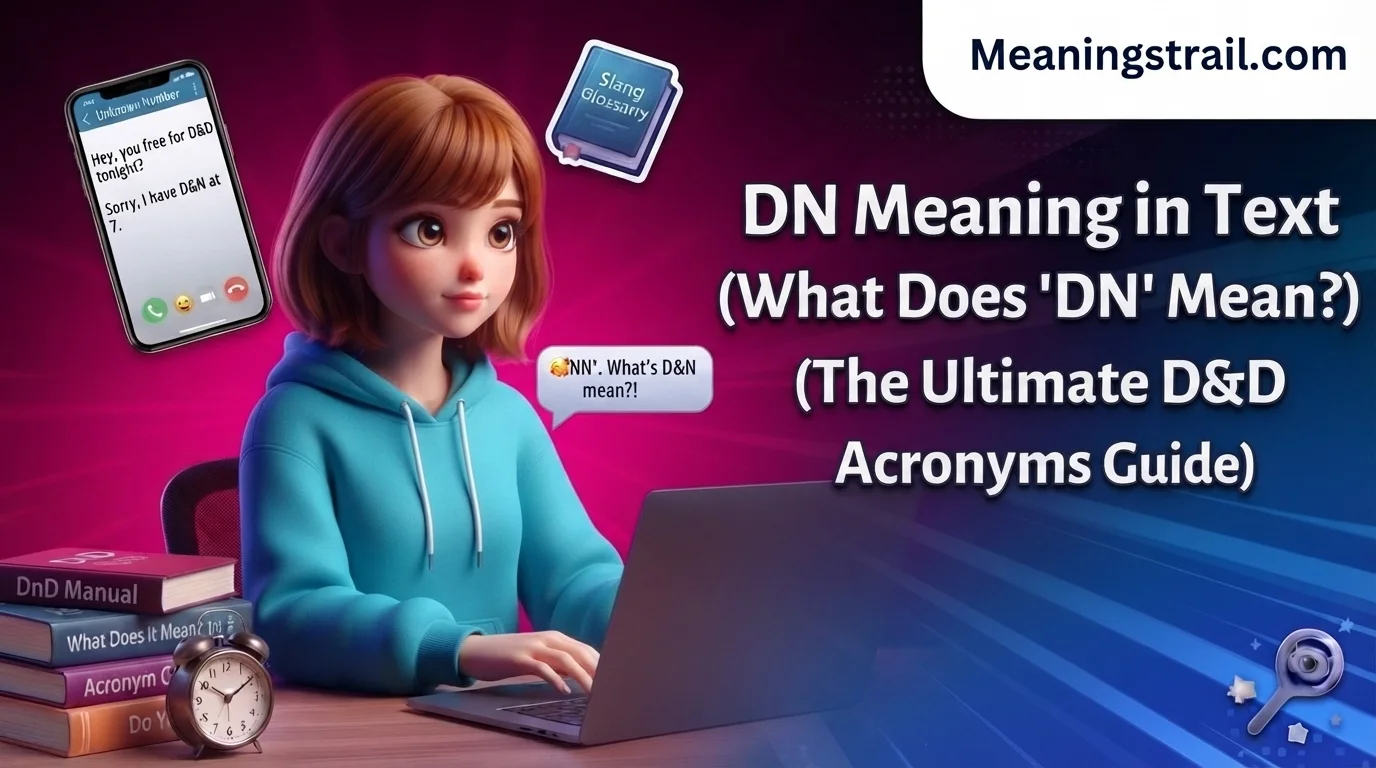
When someone sends you “DN MEANING IN TEXT” in a text, it can leave you wondering what they actually mean. Is it “down”? “Do not”? “Don’t know”? Or is it part of a joke you are supposed to understand?
This is why people search for DN MEANING IN TEXT. Short forms can save time, but they can also create confusion when the same two letters have different meanings. The meaning can change based on the sentence, the person sending it, and the platform where you see it.
For example, “Are you dn for dinner?” may suggest “Are you down for dinner?” But “dn touch that” could be an informal way of writing “do not touch that.” In another online conversation, DN may refer to a display name or appear as part of a meme joke.
The key is not to guess from the letters alone. Look at the words around “DN MEANING IN TEXT” and the purpose of the conversation. This guide explains the most useful meanings, real examples, tone, replies, and situations where you should avoid using it.
What Does “DN Meaning in Text” Mean in Text?
“DN” is a short abbreviation whose meaning depends on context. In casual messages, it can mean “down,” “do not,” “don’t know,” or “Deez Nuts” in joke-based conversations. It can also mean “display name” in social media or online-profile discussions. The sentence around DN usually tells you which meaning is intended.
The important thing to remember is that DN does not have one universal meaning. Unlike common abbreviations such as “LOL” or “BRB,” its meaning can change quickly.
For example:
- “You dn to go?” = Are you down to go?
- “DN forget your keys.” = Do not forget your keys.
- “dn yet.” = Could mean don’t know yet, depending on the person.
- “What’s your DN?” = Could mean display name.
- “DN” in a joke = May refer to Deez Nuts.
So, before deciding what DN means, read the full message.
The Most Common Meanings of “DN Meaning in Text”
1. DN = Down
One common casual use of “DN” is down.
Here, “down” means willing, interested, or ready to do something. It is often used when friends are making plans.
For example:
“You dn for pizza?”
This can mean:
“Are you down for pizza?”
Another example:
“I’m dn.”
This can mean:
“I’m down.”
In other words, the person is saying they are interested or willing to join.
This use is most likely when DN appears near words such as “for,” “to,” “go,” “come,” or an activity.
Example:
“Movie tonight. You dn?”
The natural meaning is:
“Do you want to go to a movie tonight?”
This version is very casual. It is better suited to friends, group chats, gaming friends, or people who already understand your texting style.
2. DN = Do Not
DN can also be used as a very short form of do not.
For example:
“DN touch my stuff.”
The intended meaning is:
“Do not touch my stuff.”
Another example:
“DN be late.”
This means:
“Do not be late.”
This use can sound direct because “do not” is already an instruction. Making it shorter does not automatically make it softer.
It can be playful between friends:
“DN eat all the fries.”
But it can also sound serious:
“DN share this message.”
That is why tone matters.
In formal writing, it is much safer to write “do not” or “don’t” instead of DN.
3. DN = Don’t Know
Some people use DN as shorthand for “don’t know.”
For example:
“When are they coming?”
“dn.”
The sender may simply mean:
“I don’t know.”
You may also see:
“dn yet.”
This can mean:
“I don’t know yet.”
However, this meaning is less standardized than “DK” for “don’t know.” If someone uses DN this way, you normally need the surrounding conversation to confirm it.
For example:
“What time should we leave?”
“dn, ask Sarah.”
Here, “dn” clearly appears to express uncertainty.
If the sentence does not make sense with “down” or “do not,” “don’t know” may be worth considering.
4. DN = Deez Nuts
In meme culture, DN can sometimes be connected to the phrase “Deez Nuts.”
This is a joke-based expression that is usually used for teasing, baiting, or setting up a punchline.
For example, someone might ask a question that sounds normal and then use “DN” as part of a joke.
This meaning is usually easy to spot when the conversation is already silly, sarcastic, or meme-heavy.
It is also more likely in casual group chats, gaming communities, comment sections, and conversations between friends who enjoy this kind of humor.
Because the phrase has a crude meaning, DN can feel inappropriate in some settings.
Do not assume every “DN” means this, though. Context is more important than the abbreviation itself.
5. DN = Display Name
On social media, gaming services, forums, and other online platforms, DN can sometimes mean display name.
A display name is the name shown publicly on an account. It may be different from a username or account handle.
For example:
“What’s your DN on Discord?”
The person may be asking:
“What is your display name on Discord?”
Another example:
“I changed my DN yesterday.”
Here, the person may be talking about changing the name people see on their profile.
This meaning is especially likely when the conversation includes words such as:
- username
- account
- profile
- tag
- Discord
- social media
- name
6. DN = Domain Name
In technology, websites, or online business discussions, DN may refer to a domain name.
For example:
“We need a new DN for the website.”
The person could be talking about buying or choosing a website address.
This is not usually the first meaning people think of in ordinary texting. The technical context makes it clearer.
If the conversation is about websites, hosting, URLs, or online brands, a technical meaning is much more likely than slang.
How to Identify the Right Meaning
When you see DN, ask three simple questions:
What is the sentence about?
If someone is making plans, “down” may fit.
What words are around DN?
If the message says “DN forget,” “do not” may fit better.
What platform or community is being used?
A profile discussion may point to “display name,” while a meme chat may point to the joke meaning.
Context solves most DN confusion.
How “DN Meaning in Text” Is Used in Real Conversations
Friends & Casual Texting
Friends are the most likely people to use DN in a loose way.
A friend may write:
“You dn for coffee?”
They probably mean:
“Are you down for coffee?”
You might reply:
“Yeah, I’m dn.”
Or:
“Nah, not today.”
Another friend might say:
“DN know what happened.”
Here, the intended meaning could be “don’t know,” depending on the person’s normal texting habits.
Casual texting has fewer rules. People often shorten words because they already understand each other.
The downside is that shortcuts can become unclear when people from different age groups, countries, or texting styles talk.
Instagram & Snapchat
Instagram and Snapchat encourage short messages because conversations often happen quickly.
DN might appear in a direct message about plans:
“You dn to come?”
It could mean:
“Are you down to come?”
In profile-related conversations, it could instead mean display name:
“What’s your DN?”
You may also see DN in meme comments or joke replies.
The platform itself does not guarantee one meaning. The conversation does.
If the message is about meeting up, “down” is a strong possibility. If it is about an account, “display name” makes more sense.
Dating Apps
DN can appear in dating conversations, but this is a situation where you should be careful.
For example:
“You dn to grab coffee this weekend?”
Here, DN probably means “down.”
The person is asking if you are interested in meeting.
However, if someone uses DN as part of a joke, the meaning may be completely different.
Dating conversations also involve tone. A short reply such as:
“dn”
could sound relaxed to one person but uninterested or confusing to another.
If the conversation is new, using clearer words is often better.
Instead of:
“dn?”
you can write:
“Are you down?”
That removes unnecessary guessing.
Gaming & Online Communities
Gaming chats often use abbreviations because players need to communicate quickly.
For example:
“dn for ranked?”
This may mean:
“Are you down for ranked?”
Another player might write:
“dn touch that button.”
The meaning could be “do not touch that button.”
Gaming communities can also use DN as part of jokes or community-specific language.
Because gaming groups often have their own slang, the best way to understand DN is to look at the entire message.
If someone says:
“DN for another round?”
they are likely asking whether you want to play another round.
Work or Professional Chat
Professional communication is different.
Even if DN seems obvious to you, another person may not understand it.
For example:
“DN send this yet.”
Could cause confusion.
Does it mean:
- “Do not send this yet”?
- “Don’t know, send this yet”?
- Something else?
In work messages, clarity matters more than saving two or three characters.
Write:
“Do not send this yet.”
or:
“Please do not send this yet.”
That sounds clearer and more professional.
The same rule applies to clients, teachers, managers, official emails, applications, and business documents.
Is “DN Meaning in Text” Rude, Flirty, or Offensive?
DN itself is not automatically rude, flirty, or offensive. The tone comes from the meaning, the surrounding words, and the relationship between the people.
When DN Feels Friendly
If DN means “down,” it can sound relaxed and friendly.
“You dn for burgers?”
This feels casual.
A friend may also use:
“I’m dn.”
to show interest in a plan.
When DN Feels Rude
If DN means “do not,” it can sound firm.
“DN message me again.”
That is clearly a strong statement.
The same letters can therefore move from friendly to harsh depending on the sentence.
When DN Can Feel Flirty
If someone says:
“You dn to hang out tonight?”
it could be completely normal.
But in a dating conversation, “down” may carry a more personal or suggestive tone depending on what they are asking.
DN itself does not automatically make a message flirty. The activity and relationship matter more.
When DN Can Be Offensive
The meme meaning connected to “Deez Nuts” can be crude.
It is usually used as a joke, but not everyone enjoys that kind of humor.
Avoid assuming that someone wants this type of joke simply because they use DN.
The safest approach is to match the other person’s tone.
How to Respond When Someone Says “DN Meaning in Text”
Your response should depend on what you think DN means.
Casual Replies
If DN means “down”:
“Yeah, I’m in.”
“Sure, I’m down.”
“Yep, what time?”
If you are not interested:
“Not today.”
“Maybe another time.”
Funny Replies
If the conversation is clearly playful, you can match the humor:
“DN what?”
“You’ll have to explain that one.”
“Okay, decode this for me.”
These replies work well when you are unsure but want to keep the conversation light.
Neutral Replies
If you do not understand the abbreviation, there is nothing wrong with asking:
“What do you mean by DN?”
Or:
“Do you mean down?”
This is often better than guessing.
Professional Replies
In a work setting, use a clear response.
If someone writes:
“DN send the file.”
You can clarify:
“Just to confirm, do you mean not to send the file yet?”
That removes ambiguity without creating unnecessary tension.
Common Misunderstandings About “DN Meaning in Text”
Assuming DN Always Means One Thing
The biggest mistake is thinking DN has one fixed definition.
It does not.
A message about weekend plans can point toward “down.” A social-media profile discussion can point toward “display name.” A meme conversation can point toward a joke meaning.
Always check context.
Confusing DN With DK
“DK” is a common abbreviation for “don’t know.”
Some people may use DN for the same idea, but it is not as clear or consistent.
So if someone writes:
“dn”
do not immediately assume they mean “don’t know.”
Look at the conversation first.
Thinking DN Is Always Slang
DN can be slang, but it can also be shorthand used in technical or account-related conversations.
A person discussing website domains may use DN differently from a person joking with friends.
Assuming It Is Always Rude
DN is not automatically rude.
“Are you dn for lunch?” can be completely friendly.
But:
“DN talk to me.”
can sound harsh.
The sentence determines the tone.
Assuming It Is Always Flirty
Seeing DN in a dating conversation does not automatically mean the person is flirting.
If someone says:
“You dn for coffee?”
they may simply want coffee.
Do not assign a romantic meaning without other signs.
Reading Too Much Into Capital Letters
“DN,” “dn,” and “Dn” can all be used casually.
Capitalization alone does not reliably tell you the meaning.
The surrounding words matter much more.
Similar Slang Terms You Should Know
DK — Usually means “don’t know” in casual texting.
DND — Commonly means “do not disturb.”
DF — Can mean “down for” in some casual chats.
DM — Means “direct message,” especially on social media.
IDK — A very common abbreviation for “I don’t know.”
BTW — Means “by the way.”
NVM — Means “never mind.”
WYA — Means “where you at?” or asks where someone is.
WYD — Means “what are you doing?”
LMK — Means “let me know.”
RN — Means “right now.”
These terms are generally easier to understand because their meanings are more established. DN is more dependent on context.
When You Should Avoid Using “DN Meaning in Text”
Professional Settings
Avoid DN in formal emails, reports, applications, business documents, and important workplace messages.
If you mean “do not,” write the full phrase.
If you mean “down,” use “interested,” “available,” or “willing,” depending on the sentence.
Clear writing is more valuable than saving a few keystrokes.
Cross-Cultural Chats
People from different countries may have different slang habits.
A shortcut that feels obvious to your friends may confuse someone who learned English in another environment.
This is especially important when talking with international clients, classmates, customers, or online friends.
When clarity matters, use the full phrase.
Sensitive Situations
Do not rely on DN when discussing serious, emotional, financial, legal, or personal matters.
For example, instead of:
“DN share this.”
write:
“Please do not share this message.”
The second version leaves much less room for confusion.
Sensitive conversations deserve clear language.
FAQs
What does DN mean in text messages?
DN can mean several things, including “down,” “do not,” “don’t know,” or a joke reference to “Deez Nuts.” The exact meaning depends on the message and context.
Does DN mean down in texting?
Yes, DN can mean “down” in casual texting. For example, “You dn for dinner?” can mean “Are you down for dinner?” However, this is not the only meaning.
Does DN mean don’t know?
Sometimes. Some people use DN as a shortcut for “don’t know,” but “DK” and “IDK” are generally clearer ways to express that meaning.
What does DN mean on Instagram?
On Instagram, DN may mean “down” in casual messages or “display name” when someone is discussing an account. Meme conversations can give it other meanings.
Is DN a rude word?
DN itself is not a rude word. However, some uses can sound harsh, and the “Deez Nuts” meaning can be crude or inappropriate in certain conversations.
What does DN mean in dating texts?
In dating conversations, DN may mean “down,” such as “Are you dn to meet?” It does not automatically mean something romantic or sexual. The rest of the message provides the real context.
Should I use DN in professional messages?
Usually, no. DN has several possible meanings, so it can create confusion. In professional communication, write the complete phrase instead.
Final Thoughts.
The meaning of DN in text depends on context more than the two letters themselves. It can mean “down,” “do not,” “don’t know,” “display name,” or appear in a meme or joke.
The easiest way to understand it is to read the entire message. Ask what the person is talking about, what words appear around DN, and what kind of conversation you are having.
If someone writes:
“You dn for dinner?”
“Down” is probably the best fit.
If they write:
“DN touch that.”
“Do not” makes more sense.
If they ask:
“What’s your DN?”
they may be talking about a display name.
And if the conversation is full of jokes, DN may have a completely different meaning.
When you are unsure, simply ask what the person means. There is no need to guess.
For your own messages, use DN only when you are confident the other person will understand it. In casual chats, slang can make conversations faster and more natural. In professional or sensitive conversations, clear words are almost always better.
Good texting is not about using the shortest possible message. It is about making sure the other person understands what you mean.

Grace Wilson is a passionate writer and language enthusiast who enjoys exploring word meanings and making complex ideas easy to understand.