You get a text that says, “IDGAF Meaning in Text” and you pause. Is the person angry? Are they joking? Are they trying to sound confident? Or do they really mean that they do not care?
If you have searched for “IDGAF Meaning in Text“, you are probably trying to understand the tone behind this short slangterm. IDGAF is common in texting, social media comments, chats, memes, and online communities.
It is usually direct, strong, and sometimes rude.
The meaning is simple, but the feeling behind it can change based on the situation. A close friend may use IDGAF as a joke, while someone in an argument may use it to show real anger or frustration.In some cases,it can even show confidence or emotionalx distance.
This guide explains what IDGAF means, how people use it in real conversations, when it can sound offensive, and how you can respond. By the end, you will know how to read the slang correctly instead of guessing from the letters alone.
What Does “IDGAF Meaning in Text” Mean in Text?
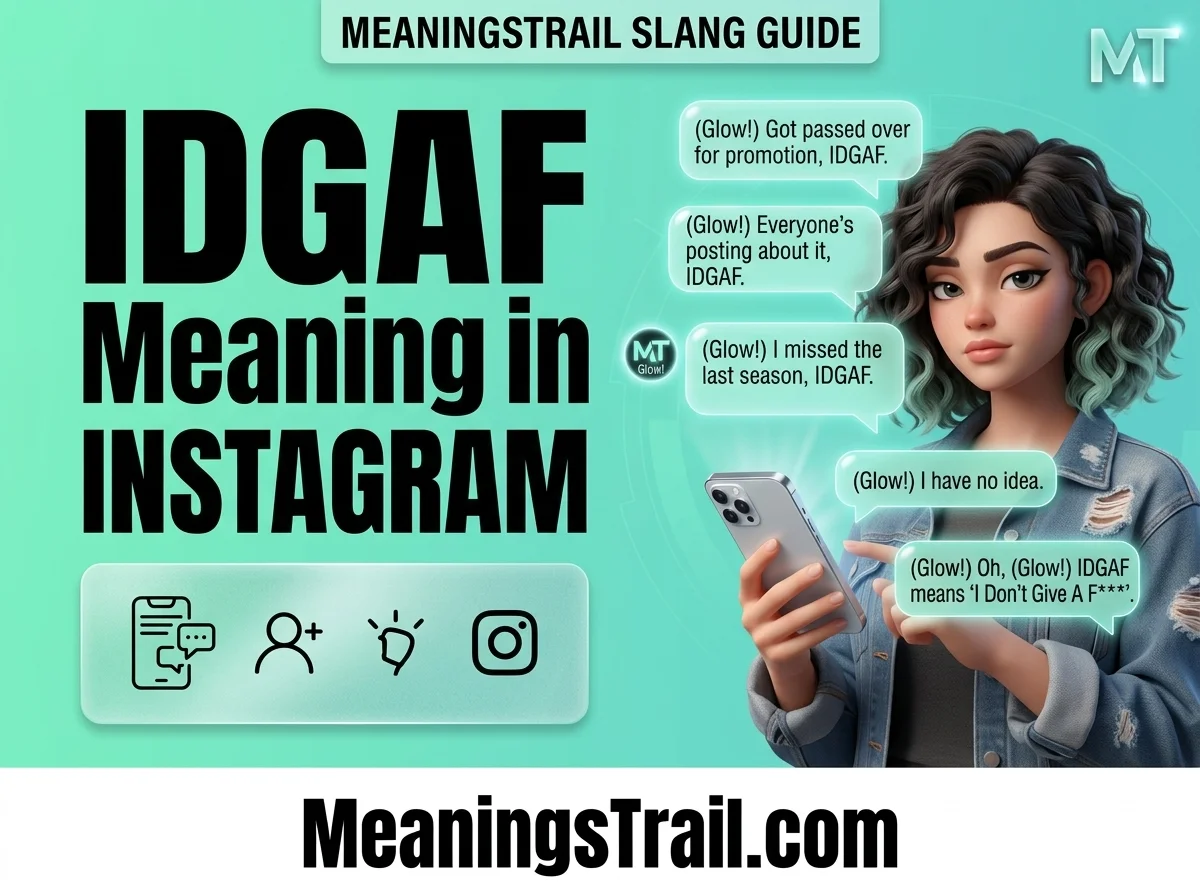
IDGAF means “I don’t give a f*.”** It is used to say that someone does not care about something. Depending on context, it can express confidence, anger, frustration, humor, or emotional distance. It is strong and contains profanity, so it is more suitable for casual chats than formal or professional communication.
The Most Common Meanings of “IDGAF Meaning in Text”
IDGAF has one basic meaning: the person is saying that they do not care. However, the reason they do not care can be very different. The surrounding message, relationship, and situation help you understand the real tone.
1. “I Don’t Care”
The most direct meaning of IDGAF is simply that the person does not care about an issue.
For example:
“People can say whatever they want. IDGAF.”
Here, the person is saying that other people’s opinions do not bother them.
This use often shows independence. The writer may feel that they should be free to make their own choices without worrying about what others think.
2. “I’m Done Caring”
IDGAF can also show emotional exhaustion.
For example:
“I tried to fix everything, but now IDGAF.”
This does not always mean the person never cared. In fact, it can mean the opposite. They may have cared for a long time but became tired, disappointed, or frustrated.
In this context, IDGAF can mean:
- I am tired of this.
- I do not want to argue anymore.
- I have stopped worrying about it.
- I am emotionally done.
The emotional meaning is often stronger than the literal words.
3. “Your Opinion Does Not Matter to Me”
Sometimes IDGAF is aimed at another person’s judgment.
For example:
“You don’t like my outfit? IDGAF.”
The speaker is rejecting criticism. They are saying that someone else’s opinion will not change what they do.
This can sound confident when used casually. However, it can also sound aggressive if the speaker is responding to someone who gave serious or helpful feedback.
4. “I’m Not Bothered”
IDGAF is sometimes used to show that something does not affect the speaker.
For example:
“They unfollowed me. IDGAF.”
The person may be saying that the unfollow does not matter to them.
But remember that text does not show facial expressions or voice tone. Someone saying “IDGAF” may truly feel nothing, or they may actually be upset and trying to appear unaffected.
That is why context matters.
5. “I’m Saying This Strongly”
Sometimes the main purpose is emphasis.
Compare:
“I don’t care.”
with:
“IDGAF.”
The second version is much stronger. The profanity makes the statement more forceful. It can communicate that the person really wants to end the discussion.
For this reason, IDGAF is not just another casual replacement for “I don’t care.” It can carry a strong emotional tone.
How “IDGAF Meaning in Text” Is Used in Real Conversations
The meaning of IDGAF becomes easier to understand when you see how it works across different online settings.
Friends & Casual Texting
Among close friends, IDGAF can be serious, playful, or exaggerated.
A friend might text:
“I ate pizza for breakfast. IDGAF.”
They are probably being funny and showing that they are not worried about normal expectations.
Another example:
“IDGAF what movie we watch. You choose.”
Here, the person may simply mean that they have no preference.
However, the same slang can become serious:
“You keep bringing it up. IDGAF anymore.”
That sounds more frustrated and may signal that the person wants the conversation to stop.
With friends, the relationship makes a big difference. Close friends often understand strong slang without taking it personally.
Instagram & Snapchat
IDGAF is common in captions, comments, stories, and private messages.
Someone may post:
“New hair. IDGAF if you like it.”
The message suggests confidence and independence.
On social media, people may also use IDGAF to create a bold attitude. A caption such as:
“Doing what makes me happy. IDGAF.”
usually means the person does not want outside opinions to control their choices.
In comments, though, IDGAF can sound more hostile:
“IDGAF about your opinion.”
This directly rejects another person’s view and can start an argument.
The public nature of social media also matters. A phrase that feels harmless between two friends can look much harsher when posted for everyone to see.
Dating Apps
IDGAF can appear in dating conversations when someone wants to show confidence or emotional distance.
For example:
“If you don’t want to meet, IDGAF.”
This sounds dismissive and possibly rude.
A more playful use could be:
“IDGAF which restaurant we pick. You have good taste.”
Here, the person is simply saying they are flexible.
However, using IDGAF while talking about feelings can easily create the wrong impression. If someone tells you that they are hurt and you reply “IDGAF,” they will probably understand it as a direct rejection of their feelings.
In dating, tone is especially important because people may already be unsure about each other’s intentions.
Gaming & Online Communities
Gamers and online communities often use IDGAF to show that they are not worried about criticism, losing, or other players’ opinions.
For example:
“They can call me a noob. IDGAF.”
The player is saying that insults do not bother them.
Another example:
“IDGAF about the ranking. I’m just playing for fun.”
Here, IDGAF means that the speaker does not care about competitive results.
Online gaming culture often includes blunt language, so IDGAF may not seem unusual among people who already communicate this way.
Still, not every community has the same standards. A gaming server with strict rules may discourage profanity even when it is common elsewhere.
Work or Professional Chat
IDGAF is generally a poor choice for professional communication.
Sending:
“IDGAF what the client thinks.”
to a coworker or manager can sound disrespectful and careless.
Even if you genuinely do not care about the issue, a professional version would be:
“I don’t think that issue should affect our decision.”
or:
“I don’t think we need to focus on that feedback right now.”
The meaning can stay similar while the tone becomes appropriate for work.
IDGAF may appear in private conversations between coworkers who are also close friends, but it is still risky in workplace writing because messages can be saved, forwarded, or misunderstood.
Is “IDGAF Meaning in Text” Rude, Flirty, or Offensive?
IDGAF is usually blunt and potentially rude, but it is not automatically offensive in every conversation.
The strongest factor is context.
When IDGAF Sounds Rude
IDGAF can sound rude when it dismisses another person’s feelings, opinion, or concern.
For example:
“You worked all night on this? IDGAF.”
That response would likely feel disrespectful because it dismisses someone’s effort.
It can also sound rude when used toward a stranger, customer, teacher, manager, or other person in a position where respectful language is expected.
When IDGAF Sounds Confident
IDGAF can show confidence when someone is refusing to let criticism control them.
For example:
“Everyone has something to say about my choices. IDGAF.”
The speaker is saying that they are comfortable being themselves.
In this setting, the phrase can feel empowering rather than hostile.
When IDGAF Sounds Funny
Close friends may use IDGAF for exaggeration.
For example:
“I know it’s midnight, but I want pancakes. IDGAF.”
The speaker probably is not angry. They are using strong slang to make a simple choice sound dramatic.
Can IDGAF Be Flirty?
IDGAF is not normally a flirty term. However, flirting depends heavily on the rest of the conversation.
Someone might use it playfully with a romantic partner:
“IDGAF what anyone says. You’re still my favorite.”
Here, the phrase itself is not the flirtation. The surrounding message creates the romantic tone.
If someone sends only “IDGAF” during a dating conversation, it is safer to read it as dismissive or indifferent rather than automatically flirty.
Why Context Changes Everything
Text messages do not contain voice tone, facial expressions, or body language. A phrase like IDGAF can therefore be interpreted in several ways.
Ask yourself:
- What were you talking about?
- Is the person normally blunt?
- Are you close friends?
- Was there an argument?
- Did they use other angry words?
- Are they joking?
- What happened immediately before the message?
These clues often reveal more than the acronym itself.
How to Respond When Someone Says “IDGAF Meaning in Text”
Your response should match the situation. If the person is joking, you can joke back. If they are angry, a calm response is usually better.
Casual Replies
If the conversation is relaxed, you can keep your reply simple:
- “Fair enough.”
- “Okay, no worries.”
- “Your choice.”
- “Got it.”
- “That’s fine with me.”
These responses work when there is no serious conflict.
Funny Replies
With a close friend, you might respond playfully:
- “Wow, someone’s feeling bold today.”
- “Message received.”
- “Okay, Mr. Unbothered.”
- “Noted. Loud and clear.”
- “You really don’t care, huh?”
Use humor only when you are confident the other person is joking.
Neutral Replies
If you are unsure about their tone, stay calm:
- “Okay. I understand.”
- “I hear you.”
- “No problem.”
- “Understood.”
- “We can leave it there.”
A neutral reply can prevent a small misunderstanding from becoming a bigger argument.
Professional Replies
If someone uses IDGAF in a work-related discussion, avoid matching their language.
You could say:
- “Understood. Let’s focus on the main issue.”
- “Okay. What do you suggest we do next?”
- “Let’s keep the discussion focused on the project.”
- “I understand your point. We can review the options.”
The goal is to move the conversation forward without adding more tension.
Common Misunderstandings About “IDGAF Meaning in Text”
IDGAF is easy to understand at a basic level, but its emotional meaning is often misunderstood.
Misunderstanding 1: IDGAF Always Means the Person Is Angry
Not necessarily.
A person may use IDGAF jokingly or confidently. For example:
“It’s raining and I still want ice cream. IDGAF.”
There is no obvious anger here.
The surrounding message determines the emotional tone.
Misunderstanding 2: IDGAF Means the Person Never Cared
This is also not always true.
Someone might say:
“I cared so much before, but now IDGAF.”
In this case, the phrase describes a change in emotion. The person may have become tired or disappointed.
Misunderstanding 3: IDGAF Is Always an Insult
The phrase can be insulting, but it is not automatically directed at a person.
Compare:
“IDGAF what people think.”
with:
“IDGAF about you.”
The first statement focuses on opinions. The second directly targets a person and is much more personal.
Misunderstanding 4: IDGAF Means “Whatever” in Every Situation
“Whatever” can sometimes be a softer version of “I don’t care,” but IDGAF is usually stronger.
“Whatever” might sound dismissive.
IDGAF can sound final, angry, rebellious, or emotionally detached.
Misunderstanding 5: A Short Reply Means the Person Hates You
Not necessarily.
People sometimes use short slang because they are busy, frustrated, joking, or simply texting quickly.
One message should not always be treated as proof of someone’s feelings.
Look at the larger conversation before making a conclusion.
Similar Slang Terms You Should Know
If you understand IDGAF, these related expressions may also appear in texts and social media.
- IDC — “I don’t care”; a shorter and usually less aggressive form.
- IDK — “I don’t know”; used when someone is unsure or does not have an answer.
- IDG — Can mean “I don’t give” in some informal contexts, but it is less complete and less common than IDGAF.
- DGAF — “Don’t give a f***”; similar to IDGAF but leaves out the “I.”
- IDGAD — “I don’t give a damn”; similar meaning but often slightly less harsh.
- IDGAS — “I don’t give a shit”; another strong way to say you do not care.
- IDCFR — An informal extension that can add emphasis to “I don’t care.”
- NVM — “Never mind”; used when someone wants to drop a topic or says the information is no longer needed.
- WTV — “Whatever”; often shows indifference or dismissal.
- IDRC — “I don’t really care”; usually softer than IDGAF.
- IDCIDC — Repeated “I don’t care,” sometimes used jokingly for extra emphasis.
- I couldn’t care less — A non-abbreviated phrase meaning something does not matter to the speaker.
The important difference is strength. Some of these expressions are casual and mild, while IDGAF includes profanity and can sound much more forceful.
When You Should Avoid Using “IDGAF Meaning in Text”
Knowing what IDGAF means is only half the job. You also need to know when not to use it.
Professional Settings
Avoid IDGAF in emails, reports, customer messages, job applications, interviews, and formal workplace chats.
Even if your meaning is harmless, the profanity can make you appear careless or disrespectful.
Use alternatives such as:
- “I don’t think it matters.”
- “I’m not concerned about that.”
- “That is not a priority for me.”
- “I don’t have a strong preference.”
These phrases communicate the same basic idea without unnecessary conflict.
Cross-Cultural Chats
People from different cultures may have very different views about profanity.
A phrase that seems normal among your friends may sound extremely disrespectful to someone from another background.
This matters even more when chatting with someone whose communication style you do not know well.
If you are unsure, choose a softer phrase.
Sensitive Situations
Avoid IDGAF when someone is discussing serious personal problems, grief, health issues, family problems, or emotional pain.
For example, if someone says:
“I’m really upset about what happened.”
Replying with “IDGAF” can cause serious hurt.
Even if you did not intend to be cruel, the phrase strongly suggests that their feelings do not matter to you.
In sensitive situations, use direct but caring language instead.
When Talking to Strangers
IDGAF can easily sound hostile when there is no existing relationship.
If a stranger gives you advice or asks about a disagreement, “I don’t agree” is usually safer than “IDGAF.”
The goal is not to avoid slang forever. It is to use slang where the relationship and setting support it.
FAQs
What does IDGAF mean in text?
IDGAF means “I don’t give a f*.”** It is a strong way to say that you do not care about something or someone’s opinion.
Is IDGAF a bad word?
Yes. IDGAF contains profanity, so it can be considered vulgar or inappropriate in formal situations. It is mainly used in casual online conversations.
Does IDGAF mean “I don’t care”?
Yes. “I don’t care” is the basic meaning of IDGAF. However, IDGAF is much stronger and can sound angry, confident, dismissive, or emotional.
Is IDGAF rude?
It can be. The phrase often sounds blunt and may seem rude when directed at another person’s feelings or opinions. Among close friends, it may be used jokingly.
Can IDGAF be used in a relationship?
Yes, but carefully. Couples or close partners may use it jokingly, but saying IDGAF during a serious emotional discussion can sound hurtful or uncaring.
What is the difference between IDC and IDGAF?
Both mean that the speaker does not care. IDC means “I don’t care” and is usually milder. IDGAF is stronger because it contains profanity and adds emotional force.
How should I respond to IDGAF?
Match the context. For a casual conversation, “Fair enough” works. If the person seems angry, use a calm reply such as “I understand.” In professional situations, avoid responding with profanity.
Final Thoughts.
The simplest answer to idgaf meaning in text is “I don’t give a f*.”** It tells someone that the speaker does not care, but the emotional message can change.
IDGAF can show confidence, frustration, humor, emotional distance, or anger. It may be harmless between close friends but sound very rude when aimed at someone’s feelings. That is why the situation matters more than the acronym alone.
When you see IDGAF in a message, do not judge the tone from the letters only. Look at what happened before it, who sent it, and how that person normally talks. A joking message and an angry argument can use the exact same acronym while carrying completely different meanings.
If you want to use IDGAF yourself, save it for informal situations where strong slang is already normal. Avoid it in professional, sensitive, or unfamiliar conversations.
Understanding slang is not only about knowing what each acronym stands for. It is about knowing when the words fit, how they may sound, and what the other person is really trying to communicate. That small difference can help you text more clearly and avoid unnecessary misunderstandings.

Grace Wilson is a passionate writer and language enthusiast who enjoys exploring word meanings and making complex ideas easy to understand.